The Divide in Organized Real Estate: How Structure and Size Influence AI Adoption


The era of artificial intelligence experimentation in organized real estate (ORE) is quickly giving way to a new strategic reality. AI is no longer simply an emerging technology; it is becoming an operational expectation. As adoption accelerates, a clear divide is beginning to form between organizations that are moving decisively and those that are still evaluating their path forward.
Findings from the T3 Sixty 2026 Planning ORE Executives Flash Poll reveal that 55% of organizations are now engaged with AI in some capacity, with 29% actively using AI tools and another 26% piloting solutions. While this signals meaningful progress, the data also reveals a growing structural divide across the industry.
Adoption is not occurring evenly. Instead, it is being shaped by two key factors: organizational structure and organizational scale.
The Complexity Penalty
One of the clearest findings from the poll is that organizational structure significantly influences AI adoption. The data shows a 34-point variance in active AI usage between specialized and combined organizations.
Organizations that operate both an Association and an MLS under a single structure face what can be described as a complexity penalty. These organizations often balance multiple governance structures, broader service mandates and competing operational priorities. This complexity can slow decision-making and create internal friction, especially when evaluating and implementing new technologies.
In contrast, specialized organizations tend to move faster:
MLS-only organizations lead the industry, with 50% reporting active AI usage.
Association-only organizations follow closely, with 44% actively using AI tools.
Combined Association/MLS organizations lag significantly, with only 16% reporting active usage.
The most telling is that 43% of combined organizations remain in the “planning to explore” phase, highlighting how structural complexity can delay adoption even when leadership recognizes the potential value of AI.
The 17x Advantage
While structure matters, organizational size may be an even stronger predictor of AI readiness.
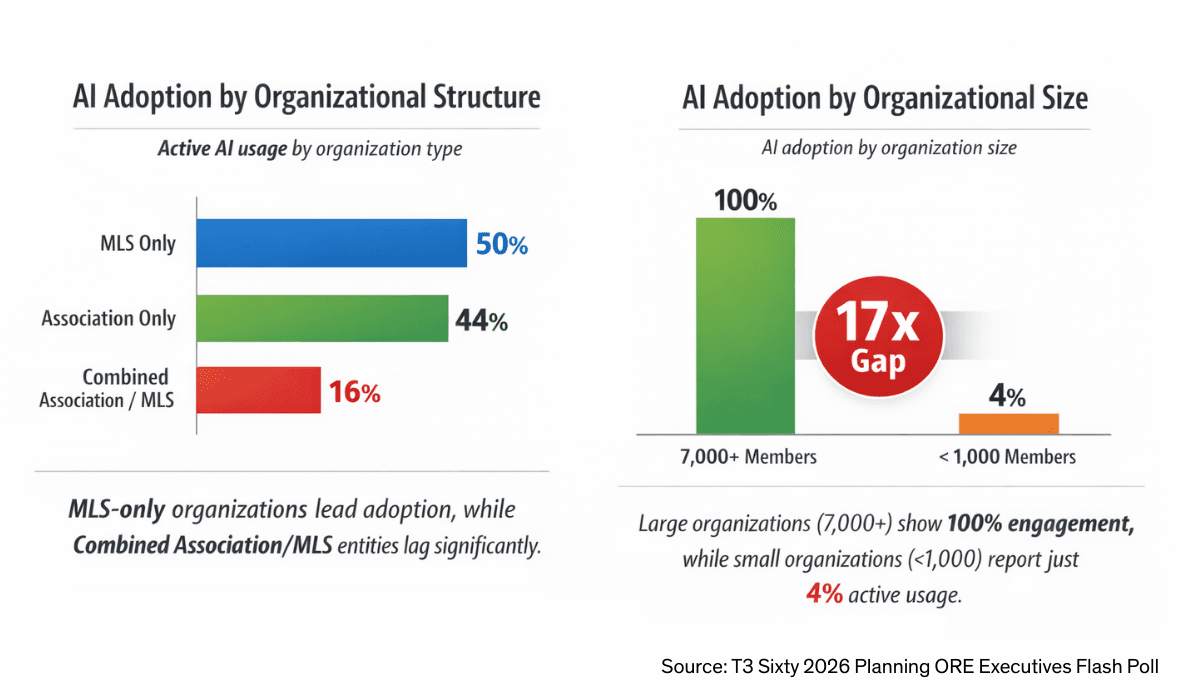
The largest organizations, those serving 7,000 or more members or subscribers, show 100% engagement with AI. Within this group, 67% report active usage, while the remaining 33% are currently piloting tools.
The picture looks very different among smaller organizations. Organizations with fewer than 1,000 members or subscribers report only a 4% active usage rate.
This creates a 17-to-1 gap in AI adoption between the largest and smallest entities in ORE. As AI becomes embedded in operational workflows, customer service and decision-making, this gap may translate into widening differences in operational efficiency, service delivery and competitive positioning.
Efficiency Over Innovation
According to the poll, ORE leaders are currently approaching AI primarily as a tool for operational optimization rather than external innovation. Rather than focusing on consumer-facing applications or transformative product offerings, most organizations are prioritizing AI’s ability to reduce workload and improve internal efficiency.
This approach reflects a broader operational reality. Nearly 28% of ORE executives cite staffing capacity and operational strain as a major challenge, making automation through AI an attractive solution.
The poll highlights several areas where leaders expect AI to have the greatest near-term impact:
Internal efficiency and workflow improvements – cited by 60% of executives
Faster member or subscriber support – identified by 38%
Cost savings or staff reallocation – expected by 37%
Improved member value and perception – noted by 29%
In essence, organizations are first deploying AI as a force multiplier for existing teams, allowing staff to shift their focus toward strategic initiatives rather than repetitive operational tasks.
The Governance Hurdle
Despite strong interest in AI technology, the primary barriers to adoption are not technological but are instead governance-related.
Many ORE leaders remain cautious due to concerns about risk, accuracy, liability and data sovereignty. According to the poll, 22% of respondents cited these issues as their primary inhibitor to adoption. These concerns are particularly relevant in organized real estate, where organizations manage sensitive proprietary data, including listing information and market insights.
Without clear protocols governing how internal data interacts with public AI models, many organizations are choosing to move cautiously rather than risk unintended exposure.
Closing the Gap
The emerging AI divide in ORE is not inevitable. But closing it will require intentional leadership.
Organizations that are making progress tend to follow a simple, structured approach:
Start with an internal audit: Identify where staff are already experimenting with AI tools and establish baseline knowledge levels.
Pilot low-risk applications: Use AI for internal tasks such as drafting communications, summarizing reports, or automating compliance reviews.
Establish clear governance policies: Define how AI tools can interact with organizational data and ensure vendor agreements protect intellectual property.
These steps allow organizations to move forward confidently without exposing themselves to unnecessary risk.
A Blueprint for Action
The message from the flash poll is clear: AI is no longer optional.
As these tools become regularly embedded in operational workflows, expectations will shift across the industry. Members, subscribers and consumers will increasingly expect faster responses, smarter insights and more efficient service delivery.
Organizations that adopt AI strategically will be better positioned to meet those expectations. Organizations that wait too long may find the gap difficult to close, due in part to the velocity of AI technology changes.
The divide between AI-enabled organizations and those still evaluating their next move is already emerging—and the distance between them is likely to grow.
For leaders across organized real estate, the opportunity is not simply to adopt AI. It is to do so deliberately, responsibly and strategically—before the competitive gap becomes permanent.