T3 Sixty Organized Real Estate Insiders Spotlight: LERA MLS and SABOR


Watch the Interview with Gilbert
How it Started
The evolution of "blended" organizations, those unique entities where local REALTOR® associations and MLSs operate under a single roof, has reached a critical crossroads. For years, the industry accepted the efficiency of a unified structure, but today’s market and legal climate are forcing a re-evaluation.
Our team’s journey with the San Antonio Board of Realtors (SABOR) began with a mapping exercise where we realized they weren't just a large organization—they were a "unicorn" in our industry's landscape. In a world of just under 1,000 associations, only a handful of entities manage the complexity of over 15,000 members while maintaining a wholly-owned MLS.
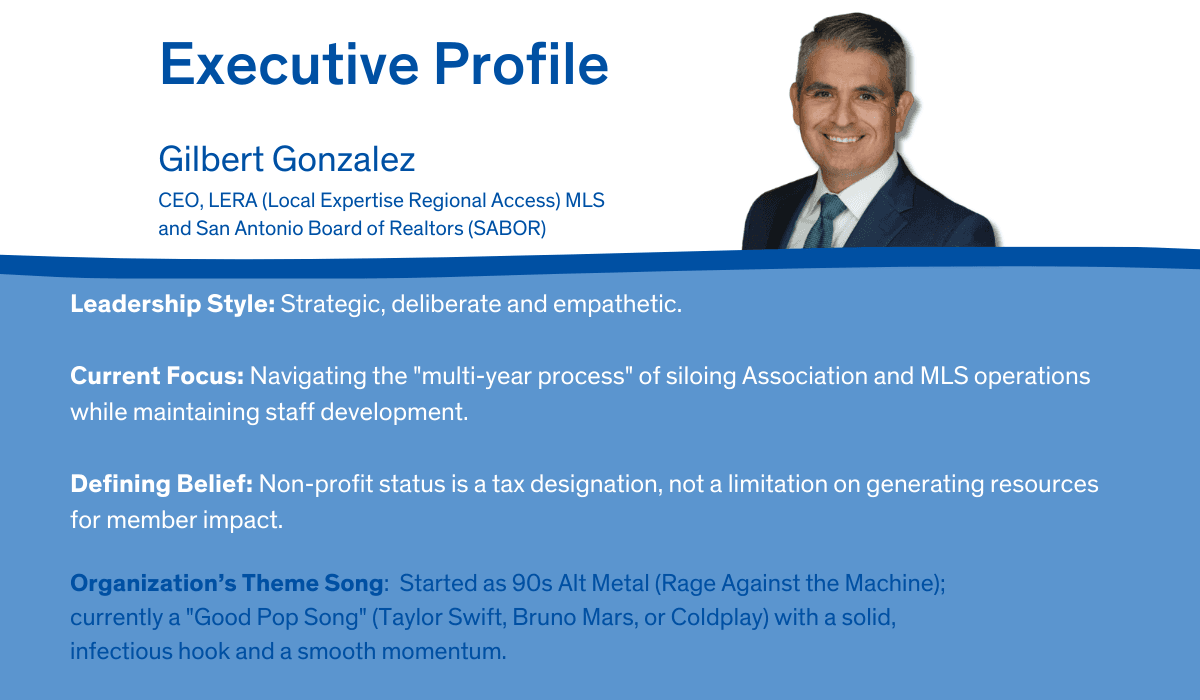
We recently sat down with Gilbert Gonzalez, the CEO of LERA (Local Expertise Regional Access) and SABOR, to discuss how he and his leadership navigated this evolution. Gilbert’s journey from an in-house lawyer to the chief executive of this century-old institution provides a masterclass in turning organizational fragmentation into strategic precision.
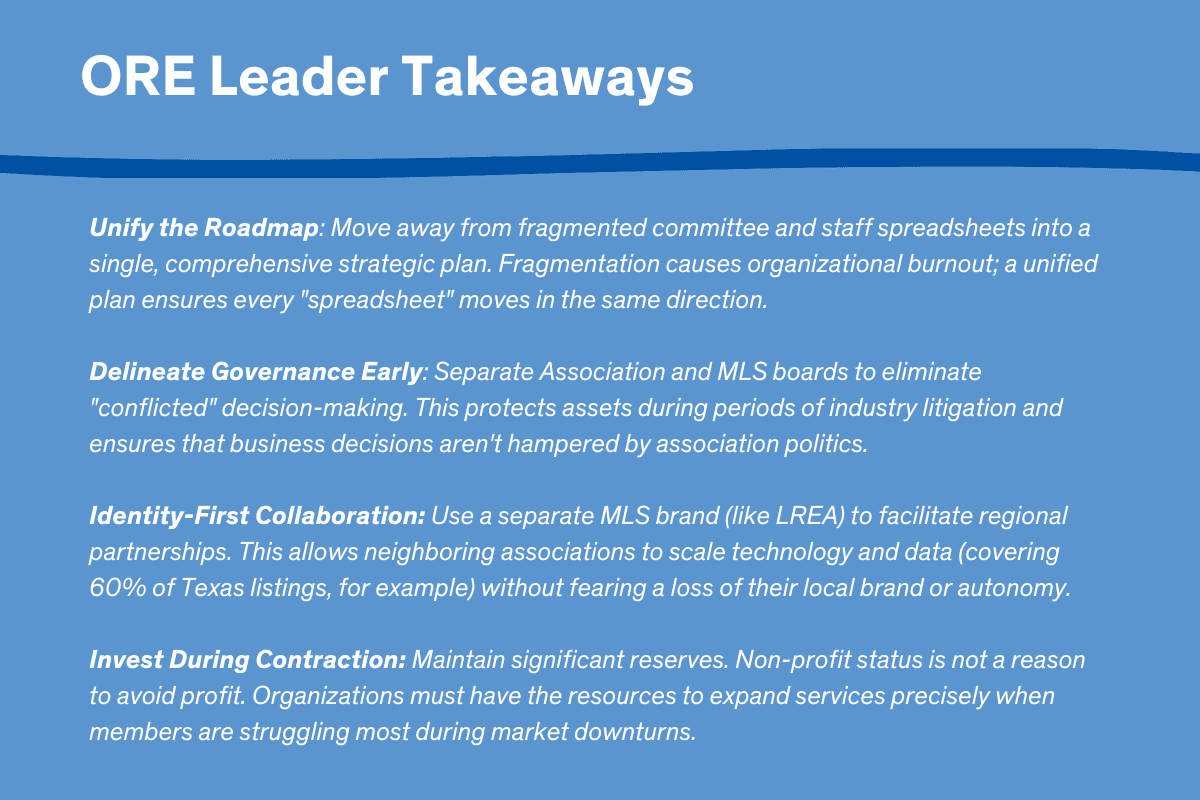
From Spreadsheets to Strategy
When we first began our engagement with SABOR in 2019, the organization was high on passion but pulling in too many directions. Attempting to be all things to all people left the association without a clear roadmap, leading to a fragmented operational environment and misaligned priorities across leadership and staff. There was a strategic plan, a business plan, a committee plan and a separate staff plan—all created within the same three-month window.
Gilbert realized that this culture was inadvertently creating burnout. "I noticed being a spreadsheet person...we had too many spreadsheets.” By combining these four fragmented roadmaps into a single, unified strategic document, the organization moved from tactical chaos to strategic and deliberate. This shift allowed the team to stop reacting to every industry trend and start moving toward a defined vision where every initiative moved the needle forward.
The Case for Separation
One of the most profound shifts for SABOR was the intentional separation of Association and MLS governance. For years, a single board of directors wore two hats, making decisions on everything from political endorsements to MLS data compliance. This created member friction. A member might say, "I can't believe I have to pay for these political endorsements just to get my MLS tools."
Gilbert’s background as a lawyer made him realize this structure was also a liability. He imagined a cross-examination in court where he’d have to admit that the Association controlled all MLS assets, potentially exposing everything to litigation."I think the board started to see, okay, I could see how this is a different decision depending on which hat I'm wearing because while this may be really good for the subscriber, maybe it's not that great for the association."
Through a siloing process, they protected the distinct value propositions of each entity. They often use an agrarian analogy: you need separate silos for different grains, but you maintain "grain belts"—synergies that transfer value between them, like using MLS data and intelligence to fuel Association advocacy. This eliminated confusion and ensured that the business of the MLS could move at the speed of technology without being slowed by the politics of the Association.
Preserving Local Identity While Scaling Regionally
Scaling an MLS is notoriously difficult because of the "identity barrier." Most neighboring associations are hesitant to partner if they feel they are being absorbed by a larger neighbor’s brand. San Antonio's pride runs deep, and Gilbert knew neighboring towns felt the same. They solved this by creating the LERA MLS brand. This shift enabled the MLS to expand its footprint and also facilitate new partnerships with major hubs like Austin and Houston without threatening the local autonomy of San Antonio.
This approachable, collaborative stance facilitated a regional database that now covers 60% of all Texas listings. By leading with the tool rather than the brand, they achieved massive scale through partnership rather than forced mergers, proving that collaboration is often more effective than acquisition.
Impact Over Status
One of the most challenging shifts SABOR leadership spearheaded was a change in the financial mindset of the organization. They challenged the common misconception that a "non-profit" should not prioritize revenue. Using the analogy of the American Heart Association, he argued that an organization’s impact is directly tied to its resources. The Heart Association doesn't stop raising money just because they’ve had a good year; they raise more to have a greater impact."The 501c6 nonprofit status is simply how we apply for our taxes. It has nothing to do with the business—the business should still be generating revenue... to continue to provide the services moving forward." By maintaining reserves, the organization ensures it can double down on member services during market contractions or significant industry shifts. It’s in those moments of downturn when REALTORS® need their association the most, and having the capital to invest when others are cutting back is the ultimate value proposition.
Legacy and Evolution
As SABOR marks its 100-year legacy, its transition into a modernized, two-silo entity represents more than just a structural change; it is a commitment to longevity.
To all ORE leaders: View your organizational evolution not as a series of quick fixes, but as a multi-year "ship-turning" process. This work requires constant, empathetic conversation and the courage to challenge legacy structures. Real change doesn't happen in a single meeting; it happens through the gradual education of your staff and volunteer leaders, which eventually empowers your organization to make sudden, decisive leadership decisions. Keep talking, keep listening and keep moving toward the unified vision that will carry your organization through its next century.